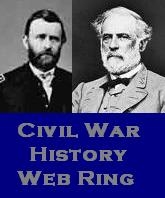

Note: As we approach the 148th anniversary of the decisive battle of the Civil War, I thought I would share two biographies that I have developed and used in a program I call Antietam Leadership Lessons. It is a presentation that I have now made on a number of occasions to senior federal government managers. It is part of a leadership development program that looks at the words and deeds of senior Antietam commanders and how they relate to leadership competencies that are part of today's Federal government Senior Executive Service (SES). Today is General Lee's story. The narrative ends as the sun rises on the morning of September 17, 1862.
Robert Edward Lee commanded the Confederate Army of Northern Virginia at the Battle of Antietam. Lee was born on January 19, 1807 at Stratford Hall Plantation in Virginia. A son of one of Virginia’s oldest families, Lee’s father, Light Horse Harry Lee led Washington’s cavalry in
 the Revolutionary War. Later on, the elder Lee served as governor of Virginia. A series of bad business ventures landed Lee’s father in debtor’s prison for a time. Seeking to restore his poor health, Lee journeyed to the West Indies, when young Robert was six and the boy never saw him again. Henry died in 1818 on his way home. His father’s circumstances had a profound effect on Lee. Though proud of his father’s wartime and political accomplishments, Lee was determined to conduct himself honorably and responsibly. Raised by his mother in somewhat modest circumstances, the prospect of a free college education and Lee’s family connections secured for the young man an appointment to the Military Academy at West Point in 1825. One of the senior classmen when Lee entered the academy was one Jefferson Davis from Mississippi. Lee graduated in 1829 ranked number two in his class. Selecting the elite Corp of Engineers as his
  branch, Lee served with distinction in various fortification and levee building projects around the nation in the 1830 and early 1840s. In 1831, he married Mary Custis, a great granddaughter of Martha Washington by her first husband. Together they raised seven children and enjoyed a happy stable home life. Over the years Mary suffered increasingly from arthritis which ultimately invalided her. In 1847, Winfield Scott, commander in chief of the US Army selected Captain Lee as one of the senior engineers for his expeditionary force in Mexico. Lee distinguished himself in several brilliant and daring reconnaissance’s deep behind enemy lines. Wounded at the battle of Chapultepec, Lee received three brevets for gallantry ending the war as a brevet colonel. His wartime success won for him the undying respect and admiration of his commander and mentor General Scott. Among the other engineers on Scott’s staff that Lee came to know was young 20 year old George McClellan, fresh out of West Point. After the war Lee resumed duties as an engineer. In 1852 he was selected to be the Superintendent of West Point. Lee improved the curriculum and facilities and spent a lot of time with the cadets. Among them were his eldest son
  Custis, and a young Virginian by the name of James Ewell Brown (JEB) Stuart. In 1855, Lee transferred to the cavalry and was assigned as the lieutenant colonel of the 2nd Cavalry Regiment in Texas. His commanding officer was another future Confederate general Albert Sydney Johnston. This was a trying time for Lee. His duty alternated between serving on court martials and pursuing the elusive Apache Indians in western Texas. The long months far away from his family were particularly difficult. In 1859 while home on leave, Lee was placed in command of the military force sent to capture John Brown at Harpers Ferry. In 1861 after 32 years in the Army, Lee was promoted to Colonel and given command of the 1st Cavalry Regiment. As the secession crisis deepened and Fort Sumter was fired upon, Lee on April 18, 1861, was offered a senior command in the Union Army by his old mentor Winfield Scott. He declined the offer, swearing to only raise his sword in the defense of his home state of Virginia. On April 19th, Virginia seceded from the Union, and Lee with a heavy heart resigned from the US Army the next day. He was offered and accepted command of the Virginia state forces on April 23, 1861. When the
  Confederate capital moved to Richmond, Lee was promoted to the rank of full General in the Confederate Army on June 14, 1861. For the next nine months, Lee served in two unfulfilling and thankless assignments. He first commanded troops in Western Virginia who were defeated by George McClellan in July of 1861. Later he was responsible for the fortification of the southeastern coast. Lee’s apparent relegation to these two assignments left some with the impression that Lee was a man who had not lived up to his potential. However Jefferson Davis was not among those who shared these sentiments. Summoned back to Richmond from Charleston in March of 1862, Lee became the President’s principal military advisor. He orchestrated Stonewall Jackson’s successful Valley Campaign in March of 1862 which threatened the Northern capital and denied reinforcements to General McClellan’s army at a critical time as it slowly advanced down the Peninsula toward Richmond. Then on May 31, Joseph Johnston commanding the Army in front of Richmond was seriously wounded in the Battle of Seven Pines. Davis, who was on the field of battle with Lee
  immediately placed his trusted lieutenant in what many viewed as temporary command of the Johnston’s army. For the next three weeks, Lee ordered the army to dig in as he reorganized and planned. He earned the nickname of “Granny Lee” and the “King of Spades” for his seeming unwillingness to fight and propensity for digging in. Porter Alexander, a Confederate staff officer with the Army asked an aide to President Jefferson Davis if he thought Lee had audacity enough to lead a field army. “Lee is audacity personified,” the man replied. “His name is audacity, and you need not be afraid of not seeing all of it that you will want to see.” That prophecy came true less than three weeks later when Lee launched a series of bloody attacks against McClellan’s forces. Lee was never quite able to trap and destroy the Union Army largely because of the inexperience of his own commanders, and tenacity of the Union soldiers. Nevertheless he drove the Federals back 30 miles. With the threat to Richmond reduced, Lee divided his army. He remained with Longstreet to observe McClellan and sent Stonewall Virginia back into the Shenandoah Valley to confront another advancing Union Army under John Pope. When Lincoln ordered the return of
  McClellan’s Army to the Washington area, Lee and Longstreet rejoined Jackson northwest of Fredericksburg and in a three week campaign smashed Pope’s Army at the Second Battle of Manassas on August 30-31. In less than 10 weeks, Lee had virtually cleared the state of Virginia of northern troops. Lee now had the initiative and had to decide what his next step would be. Lee advised President Davis of the desirability of moving into Maryland. Having worked closely with President Davis in previous assignments and knowing his demand for constant, up to date and detailed information, Lee maintained a regular correspondence with the President throughout his command. Davis, himself a West Point graduate and former Secretary of War in the Pierce administration considered himself a military expert and would have much preferred a general officers commission in the Confederate Army to the Presidency. A distant and often extremely difficult man to work with, Davis never established the same amiable working relationship with any of his other army commanders, as he had with Lee. Davis therefore readily concurred with Lee’s proposal. Though much reduced by battle, fatigue and straggling, Lee’s army now aptly named the Army of Northern Virginia, crossed the Potomac River into Maryland on September 4, 1862. Lee’s plan was to draw the defeated Union Army out of its Washington fortifications and deep into Maryland or Pennsylvania. There, he expected to inflict a final devastating defeat on
  ground of his choosing and end the war. On September 9th his army was resting at Frederick. Lee developed Special Order 191, his plan for the capture of Harpers Ferry and the resumption of his offensive. He again divided his army and sent Stonewall Jackson to clear Harpers Ferry. Lee moved with Longstreet, to Hagerstown Maryland, and left a thin line of infantry and cavalry to guard his rear along the South Mountain passes. Lee was confidant that the Union Army would not appear until long after Jackson had captured Harper’s Ferry and rejoined him near the Pennsylvania border. But his plans went awry. It took Jackson longer than planned to encircle Harpers Ferry. Meanwhile, McClellan advanced faster than Lee anticipated. Moving into Frederick, he discovered a copy of Lee’s Special Order 191 left in a farm field near one of the Confederate camps. McClellan now realized that he was perfectly positioned between the widely separated wings of Lee’s Army to defeat each one in detail. McClellan’s push through the passes on September 14th forced Lee to reconsider his campaign. With Harpers Ferry still besieged and McClellan between the two wings of the Army, Lee briefly considered withdrawing into Virginia.
  However, Jackson’s message late on the 14th predicting the eminent surrender of Harpers Ferry the next day convinced Lee to stand his ground in Maryland. He withdrew Longstreet’s battered forces to the west bank of Antietam Creek and boldly awaited McClellan’s approach. When the sun came up on the morning of September 17, 1862, Lee’s army of less than 40,000 men faced the Union Army of the Potomac with nearly 87,000 men. Somewhere out there among those 40,000 men was Lee’s 18 year old son, Robert E Lee Jr, a private in an artillery battery sure to be in the most severe of the fighting. The bloodiest battle in American history was about to begin.



 isit the battlefield, be sure to ask specifically for the one showing A.P. Hills route. There is another map for travelers who desire the most direct path to and from Harpers Ferry. I took a third route from Sharpsburg to Harpers Ferry that followed the scenic Harpers Ferry Road along the Maryland side of the Potomac River.


 Posts
Posts