About Me
- Jim Rosebrock
- I am a lifelong student of military history with particular interest in the Battle of Antietam. I work for the federal government in Washington DC and have two young adult children who I love very much. I currently volunteer at Antietam and devote much time to the study of this battle and the Maryland Campaign. I enjoy collecting notable contemporary quotations by and about the men of Antietam. Since 2013 I have been conducting in depth research on the regular artillery companies of the Union Army and their leaders. I hope to turn this into a book on this subject in the future. My perspective comes from a 28-year career in the U.S. Army. Travels took me to World War II battlefields in Europe and the Pacific where American valor ended the tyranny of Nazism and Empire. But our country faced its own greatest challenge 80 years earlier during the Civil War. And it was the critical late summer of 1862, when Robert E. Lee launched the Maryland Campaign. It is an incredible story of drama, carnage, bravery, and missed opportunities that culminated around the fields and woodlots of peaceful Sharpsburg MD. So join me as I make this journey South from the North Woods.
Sunday, December 18, 2011
Virtual Antietam 2.0
I just came across a great upgrade of Stephen Reckers
Virtual Antietam website that now includes a blog. Stephen is a fellow battlefield guide at Antietam who helped me get my start as a guide four years ago. He has
many great projects that are ongoing including his long awaited book Rare Images
of Antietam, Vol. 1 that he says will be coming out in July of next
year. Check out Stephens important
work here.
Tuesday, December 13, 2011
Statistical Graphing - West Pointers at Antietam
Several years ago, I attended a terrific one-day course by
Edward Tufte, professor at Yale University and author of Envisioning Information, Visual Explanations, and The Visual Display of Quantitative Information.
Tufte used Charles Joseph Minard’s chart plotting Napoleon’s March to Moscow
during the War of 1812 as an example of perhaps “the best statistical graphic
ever drawn.” I was so taken by
this depiction that I have since purchased and framed this chart. It now hangs in my office at home as a
constant challenge to be innovative in portraying information. If you ever have an opportunity to
attend a Tufte seminar, run don’t walk.
I have lately become interested in exploring the
relationships of the West Pointers that served at Antietam on both sides of the
battle. A terrific website by Bill Thayer at the University of
Chicago introduced me to Cullem’s Register. The Register is a compendium of the service records of
thousands of West Point graduates over the years. I further contacted the West Point library and obtained a link to the pdf files of the register.
What I have been doing (to the neglect of other projects
sadly) is sifting through this mass of data to extract a list of every West
Point graduate who fought at Antietam or served in some capacity in the
Maryland Campaign. There some
193 men on the list ranging from Joseph K. F. Mansfield, number 2 in the class of
1822 to Charles N. Warner, number 28 (and Immortal) in the Class of 1862. I created a table that summarizes their
military careers, regimental assignments, stints at West Point as faculty
members, war service (in Mexico, Florida, Utah, Spanish American War and yes
even World War One), home states, and other things. For the more obscure men, I have reviewed OR 19 and 51 to see if they are mentioned, and amazingly many of them are. I have drawn out some interesting correlations
about their careers that I look forward to sharing. This effort has taught me a lot about the Regular Army in the
antebellum period before the Civil War and much about post war assignments as well.
With Minard’s chart on the War of 1812 (the European War of 1812 that
is) in mind, I attempted to depict some of this information on a chart of my
own. It is essentially a diagonal time line
from the Class of 1822 (top left) which was Mansfield's class to the Class of 1862 (bottom right) that
sent 14 newly minted second lieutenants to the battle including young Charles
Warner. Generally the colors above the line reflect United States or Confederate States affiliation during the war. The green lines are periods when the specific officer taught at West Point. The white spots which drift from the top of the chart halfway across the top are Mexican War officers who received brevets for gallantry. The colors below the time line diagonal are the regimental affiliations of the officers. Light red is artillery, light blue is infantry and gold is cavalry. Engineers, topographical engineers and ordnance officers are also shown.
The initial objective was to group cadets by year group showing not just who they graduated with, but who were other students in upper and lower classes when they were at the academy. I call this relationship spans of connection. For example, members of the class of 1846 (the big black box in the upper left quadrant) as fourth year cadets in the fall of 1842 would have known cadets who would graduate as the class of 1843. Four years later as first year cadets themselves, these men would have known the fourth year cadets who would go on to graduate in 1849. After their own classmates, they were likely closest to classmates in the classes of 1845 and 1847 (the red boxes). The colors are less dark as you move away from 1846 (orange, gold, yellow). Cadets in the five year program of the late 1850s would have even larger spans of connection. This effort alone was very illuminating. There is much more that I will address down the road but here is a peak at the chart. Stay tuned.
![]() |
| West Pointers at Antietam 1822 1862 |
Wednesday, November 23, 2011
The Impending Crisis
I am currently reading David Potter’s monumental work The Impending Crisis America Before the
Civil War 1848-1861 (New York: Harper, 1976).
In his chapter titled the Political Parties in
Metamorphosis, I read this passage on political parties. Potter is discussing the Whig and
Democratic parties in the decades before the Civil War. In view of repeated failures of our
modern legislative branch to legislate, (the Super Committee being the latest
example) I found Potter’s words on the characteristics of the American
political parties very interesting.
I keep coming back to this paragraph on page 226.
Relatively
unencumbered by ideological mission, the two parties did not have enough
intellectual focus to offer voters clear-cut alternatives. Thus they failed in one of the classic
functions theoretically ascribed to political parties. But if they defaulted in
this way, they performed admirably another equally important if less orthodox
function: the promoted consensus rather than divisiveness. By encouraging men to seek a broad basis
of popular support, they nourished cohesiveness within a community and avoided
sharpening the cutting edge of disagreement to dangerous keenness. Without ideological agreement as a
basis for cohesiveness, the parties could still cultivate unity, based upon the
practical need that diverse groups may have for one another’s support.
I rarely use this blog as a political forum. However, I truly believe that we are at the other end of the pendulum
these days. There is to much
intellectual focus. The
alternatives are clear-cut nowadays.
But what our leaders seem to posses in abundance in clarity of position,
they forfeit in ability to promote consensus and fail to seek broad basis of
popular support. The American
people clearly recognize the problems.
But our leaders seem incapable of working together to make decisions. Now
this very divisiveness that is so well promoted in the 21st century
could very well mean our decline.
Nothing is getting done. We
cant stand further putting off of the key decisions that need to be made right now.
Henry Clay, John Q. Adams, Daniel Webster, Stephen Douglas, and John Calhoun have
been replaced by Harry Reid, Mitch McConnell, John Boehner, and Nancy Pelosi,
prisoners of their own special interest keepers. There are many times to hold firm to our ideological
standards but surrendering any idea of compromise or bipartisanship all the
time is unacceptable.
Impending Crisis then or now? But that’s just me.
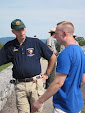
Thursday, November 10, 2011
The Marine Corps is 236 Today. Thanks to one Marine in Particular
![]() |
| Lance Corporal Jim Rosebrock |
Several of Jim's high school friends that I know serve now. One is a United States Army Ranger enroute to a deployment of his own after Thanksgiving, and another is finishing up boot camp at Parris Island. Another will be commissioned as Army lieutenant out of ROTC next spring. Five years ago, I took these boys to the Boy Scout Philmont Camp in New Mexico. Now they proudly serve their nation.
To those who have little positive to say about the young of this generation, I say look at men like Jim who are laying it on the line everyday. As an old paratrooper, I know that they have learned the same lesson that I did many years ago - that the best in life is earned, not handed to you.
Lets not forget our veterans this weekend - all the soldiers, sailors, marines, airmen, and coast guardsman who put it on the line every day for us. If you see one thank one. And better yet, don't just do it on Veteran's Day. Go out of your way to make every day Veteran's Day.
Sunday, November 6, 2011
Ride the Auto Tour!!
Antietam volunteer Dave Maher shot this great video from his car yesterday. It covers about the first five auto tour stops at Antietam National Battlefield. The crystal clear skies and beautiful fall foliage are really accented here. The video is in real time. Dave, I am looking to more footage soon. Thanks again.
Friday, November 4, 2011
An Honor
| From left to right Mannie Gentile, Alan Schmidt, daughter Rachel, me, Dan Vermilya, Bob Casey, Christie Stanczak and Joe Nicodemus. (Photo courtesy of Mannie Gentile) |
| It was great to be joined by fellow volunteer and lovely daughter Rachel. (Photo courtesy of Mannie Gentile) |
It is great to be recognized for something you like to do but even greater to work with and be a part of the finest interpretive staff of rangers, volunteers, and guides in the Service. While I say thanks to all of them for a job well done, I want to say a special thanks to Ranger Christie Stanczak, volunteer coordinator and very dear friend for making this possible.
Tuesday, November 1, 2011
Final Attack Trail Work Party This Saturday
Last weekend's SHAF workday to begin the walking trail up to the Eighth Connecticut and Ninth New York monuments was snowed out. There will be a work party this Saturday November 5th led by Antietam Ranger Joe Calzarette to work on this trail. Meet at the Antietam Visitor's Center at 9AM. Bring gloves, water, and dress for the weather. Right now the weather forecast looks good but as last weekend if there is a steady rain that morning, the event will be cancelled.
Subscribe to:
Posts (Atom)


